

Training is only the beginning. Learn how knowledge management practices can keep knowledge flowing after formal learning ends and turn individual insights into shared organizational knowledge.
Proving Impact, Driving Results
Fall 2026


Features This Issue

Good training starts with good writing. Learn four ways to create relevant, consistent and practical training content that learners can understand and apply.

Career growth rarely follows a straight line. Workforce data shows how lateral and cross-family moves can support retention and how L&D can build the infrastructure employees need to pursue them.

Frontline training creates greater business value when L&D starts with the performance metric. Learn how to diagnose gaps, design targeted solutions and measure results with operational partners.

L&D’s cross-functional perspective can make it a strategic unifier, connecting people, systems and priorities to create greater clarity, coherence and coordinated action.

Too many worthwhile learning initiatives can create strategic fatigue. Learn how L&D leaders can manage capacity, prioritize their portfolios and protect the time employees need to practice, apply and improve.
5 Nov 202611:00 am ET

Training Industry’s Senior L&D Leader Competency Model defines seven core responsibilities for moving from functional L&D expertise to strategic, executive-level leadership.
Callout
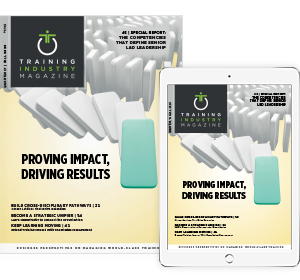
Training Industry Magazine
Best practices for developing effective training programs.
Thought Leaders This Issue

A “good enough” LMS may deliver courses, but it cannot meet every performance need. Learn how L&D can build a broader technology ecosystem that enables employees in the flow of work.
Training shouldn’t be judged only by course completion or assessment scores. The real measure of impact is what employees do differently because of what they learned.
Career development does not have to feel like another formal process. Discover three game-inspired activities that can make career conversations more engaging, honest and meaningful.
Preparing for senior L&D leadership takes more than earning a bigger title. Learn how experiences that expand business scope, financial responsibility and influence can build your capacity for impact.

Neha Trivedi, CPTM, shares her journey into L&D and lessons on stakeholder relationships, inclusive learning, AI, professional development and building a diverse career.

Training is more likely to create business impact when leaders stay involved before, during and after the learning experience. Learn four ways managers can strengthen training transfer and workplace application.

AI can redesign how work gets done, but it does not automatically prepare people for that change. Learn how brain science can help L&D strengthen the human capabilities employees need alongside AI.
Training alone cannot create high performance when workplace culture works against it. Learn how L&D can diagnose cultural barriers, reinforce desired behaviors and identify when training is not the right solution.
Info Exchanges This Issue
Scalable training operations start with workflows, not platforms. See how Sweetwater used automation, integrations and incremental system design to reduce administrative work and build a learning ecosystem that could grow with the business.

Employees need time to learn, connect and grow. Explore practical strategies for building development programs that involve managers, strengthen relationships and support employee growth.

Training doesn’t end when learners leave the classroom. Explore five low-cost, scalable methods for reinforcing learning, improving retention and supporting lasting behavior change.
Learners’ questions, confusion, reflections and behaviors can reveal how to improve training. Learn how to turn learner input into more relevant and engaging learning experiences.
The LMS is only one part of how employees learn. L&D can create greater impact by looking across the knowledge ecosystem and asking whether available knowledge actually builds capability.
OpenSesame is expanding its learning ecosystem through partnerships with MIT Sloan Management Review, Second City Works and Vector Solutions, adding content in AI strategy, human skills and workplace safety.
Older Articles

Learning campaigns help employees engage with low-priority training through gamification, peer discussion and spaced learning experiences.

Organizations build stronger learning cultures when training is relevant, supported by managers and reinforced through collaboration.

Employee engagement improves when workplace learning feels relevant, supported and connected to meaningful career growth opportunities.

Effective workplace learning depends not just on software, but on employees having reliable access to the right devices.

Values-driven learning programs help organizations build stronger cultures, improve leadership alignment and support growth across global teams.

Mentoring relationships lose momentum when communication, trust and purposeful conversations begin to break down over time.
Learn how the Alchemist Group expands it capabilities and scales training with acquisition of The Experiential Learning Group.

What drives one employee may deter another. What energizes one person might leave someone else overwhelmed. Some employees thrive when given autonomy and opportunities to experiment, while others seek structure and a clear path forward.

Learning and development (L&D) professionals spend their careers helping others learn, grow and adapt. The irony is that we often struggle to stay intentional about our own professional development.

AI delivers instant answers, but organizations risk losing the curiosity and productive struggle that drive innovation.
Stay up to date on the latest articles, webinars and resources for learning and development.